
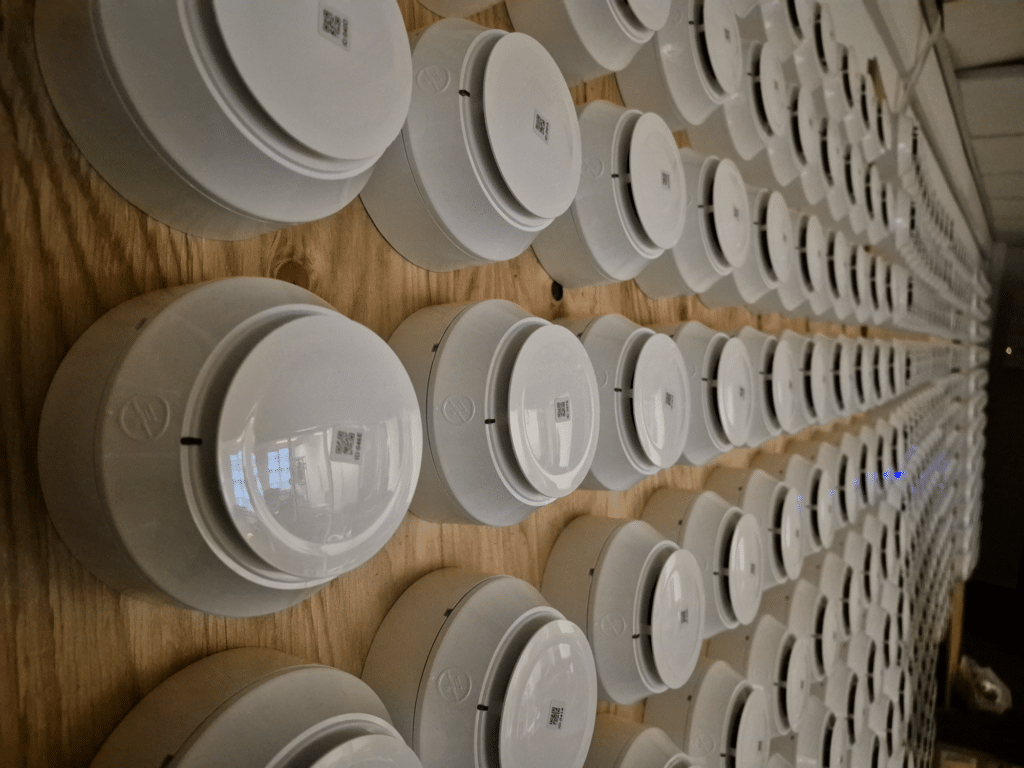
Wireless fire detection systems offer several advantages over traditional wired systems. Installation can be faster and at lower cost since no wiring is needed, resulting in minimal disruption of the daily use of the building. And being wireless, detectors can easily be repositioned as the building is remodelled and floorplans altered.
Among the challenges involved are battery lifetime, range, link budget and responsiveness in terms of latency. Other challenges relate to different regulations that vary from country to country – how to create a solution which satisfies as many countries as possible.
The advantages of having fire detectors connected in a network are many:
- Enhanced Detection Accuracy: Networked fire detectors can communicate with each other, allowing them to cross-verify signals and improve detection accuracy. This reduces the likelihood of false alarms or missed detections.
- Faster Response Time: When one device detects smoke or fire, it can immediately signal all other connected detectors in the network. This enables a faster response time, which is crucial for early warning and quick action to mitigate the spread of fire.
- Comprehensive Coverage: Networked detectors can cover larger areas more effectively than standalone detectors. They can be strategically placed throughout a building to ensure comprehensive coverage, reducing blind spots where fires may go undetected.
- Remote Monitoring and Management: Networked fire detection systems offer remote monitoring and management capabilities. This allows building managers and authorities to monitor the status of detectors in real-time, receive alerts, and even control settings remotely.
- Integration with Building Systems: Networked fire detection systems can often integrate with other building systems such as HVAC, access control, and emergency lighting. Integration enables automated responses such as ventilation control, door unlocking, or lighting activation in the event of a fire.
- Scalability and Flexibility: Networked systems are often scalable, allowing for easy expansion or reconfiguration as building layouts change and needs evolve. Additional detectors can be added to the network without adding complexity or requiring infrastructure changes.
- Diagnostic Capabilities: Networked systems can provide diagnostic information, such as the status of individual detectors, battery levels, and system health. This facilitates proactive maintenance and troubleshooting, ensuring that the system remains reliable.
- Cost Efficiency: While the upfront cost of installing a networked fire detection system may be higher than standalone detectors, the long-term cost savings can be significant. By reducing false alarms, enabling faster response times, and facilitating proactive maintenance, networked systems ultimately save money over their lifespan.
However, when installing a networked fire detection system the following considerations must be taken into account:
- Adaptability – allow for changes as the building’s use changes. As occupying tenants move in and out, the building will undergo a constant change. It must be easy to install or move fire detectors according to these changes.
- Reliability – no critical devices or weak points – such as wires or mains powered routers – which may render the network, or parts of the network inoperable.
Benefits of NeoMesh:
Using NeoMesh to create wirelessly connected fire detectors does exactly this. Thousands of fire detectors can be deployed in the same building, or in the same forest, on the same network. Because no wired infrastructure is needed, installation is made at lower cost and with increased flexibility. Subsequent changes can be easily accommodated simply by repositioning, replacing or adding more detectors.
With NeoMesh, no repeaters are needed. Just install the fire detectors where they are needed and they will automatically connect to each other and to a gateway / central fire panel. The low power operation of the detectors will provide years of battery lifetime. As power consumption will be the same for all devices, battery replacement for all detectors can be done at the same time as a scheduled activity.
- No repeaters or cabled infrastructure are needed.
- Scalability in network size: up to 65,000 devices – no limitation in how many hops. No building or forest too large.
- Choice of sub-GHz for longer range or 2.4 GHz for global standard.
- ….or 2.4GHz LoRa – global AND long range
- Supports collecting other data, such as heat, temperature, CO and battery status
- Missing / non-operable detectors will be detected by the network
- Local grouping possible
- Battery power will last for several years

Frequently asked questions
Contact
NAVIGATION